Yahuah did not let much be known about the Judges except for Samson, for a judge must be above reproach. But we do know that he rescued Samson when he sought The Most High at the end of his life
By Jacob Edson
The 12 Judges of Israel
Here is a brief overview of each leader in the book of judges.
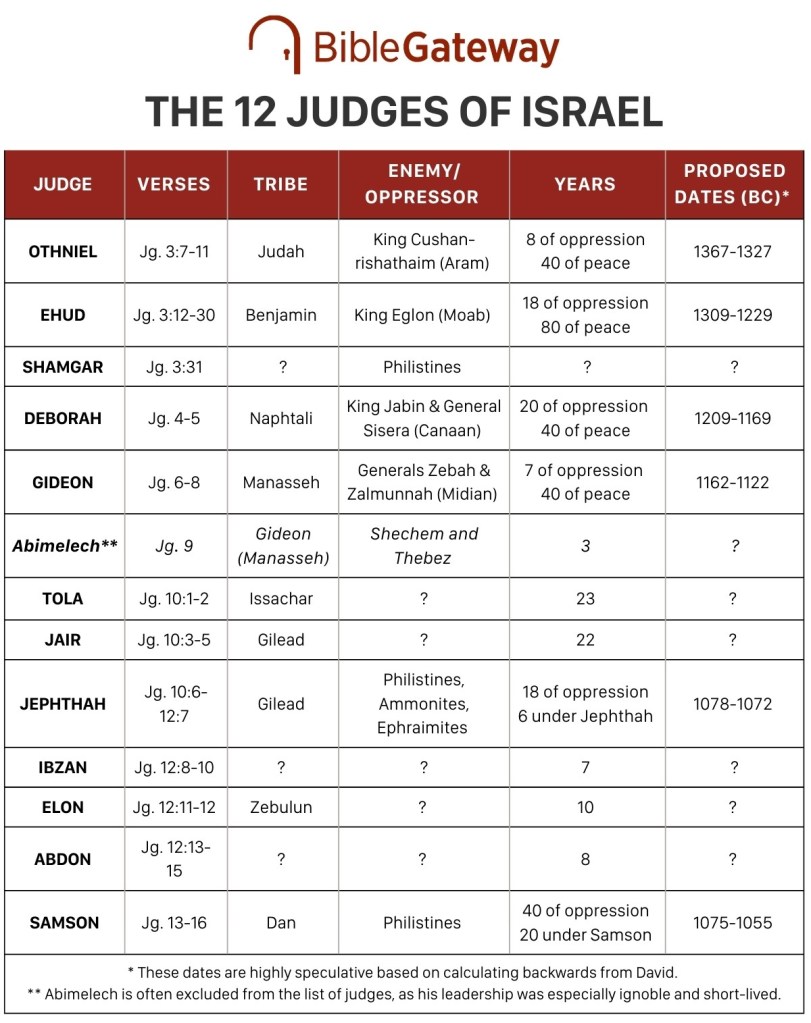
Judges 3:7-11
Tribe: Judah
Enemy: Aram (8 years of oppression)
Proposed dates: 1367-1327 BC
Othniel defeats King Cushan-rishathaim of Aram-naharaim, ushering in 40 years of peace for Israel.
Ehud
Judges 3:12-30
Tribe: Benjamin
Enemy: Moab (18 years of oppression)
Proposed dates: 1309-1229 BC
Ehud, who the text specifies as being left-handed, is most known for assassinating King Eglon of Moab by hiding a short sword in his pants and requesting a private audience with the king. He then buries the entire foot-and-a-half-long blade and hilt in the obese King Eglon’s stomach.
Moab’s defeat is followed by 80 years of peace for Israel — by far the longest armistice in the book.
Shamgar
- Judges 3:31
- Tribe: Unknown
- Enemy: Philistines
- Proposed dates: Unknown
Little is known about Shamgar, who exists in the Bible mostly as a footnote to Ehud, other than that he “also” rescued Israel. His claim to fame is striking down 600 Philistines with an animal prod.
Deborah
- Judges 4-5
- Naphtali
- Enemy: Canaan (20 years of oppression)
- Proposed dates: 1209-1169 BC
Deborah was a prophetess and the only female judge. Upon rising to power, she instructs her general Barak to lead her army against Canaan, who had been oppressing Israel for 20 years under King Jabin and his General Sisera. Barak refuses to go without Deborah by his side, a request which she readily obliges. Together with 10,000 men they defeat Sisera’s army, which includes 900 iron chariots (we are not told how many men), leaving none alive.
Sisera himself escapes, however, and hides in the tent of Jael, a woman whose house is neutral in the conflict. While he sleeps, she drives a tent peg through his skull with a hammer.
His great general thus defeated, King Jabin is considerably weakened and soon defeated by the Israelites.
Gideon
- Judges 6-8
- Tribe: Manasseh
- Enemy: Midian (7 of oppression)
- Proposed dates: 1162-1122 BC
Gideon initially doubts God’s call and requests a sign, which the Lord provides. The Lord then asks Gideon to destroy the altars to Baal and the Asherah poles the Israelites have been using for worship. When the people discover his actions the next day, they call for Gideon’s execution — but his father Joash says Baal could argue his own case against Gideon, earning Gideon the epithet Jerubbaal, “let Baal argue with him.”
Gideon, still unconvinced, requests another sign (or two) before battle with Midian: first that there would be dew only on his fleece and not on the ground, and then only on the ground and not on his fleece. Both times God accepts and provides the requested sign.
Once Gideon is finally ready, though, God tells Gideon he has too many men, which might cause them to take credit for their own salvation. At God’s request, Gideon announces that anyone who wants may go home; 22,000 do so, which leaves 10,000 remaining. God decides that is still too many, so he narrows them down to just 300. With that number they attack at night and rout the entire Midianite army.
Here’s where it starts to get grisly. The people of Succoth and Penuel refuse to provide sustenance for Gideon’s army while they chase the Midianite generals Zebah and Zalmunna across the Jordan River. So after he catch them, Gideon returns and beats their leaders, destroys the tower of Penuel, and slaughters the local residents.
Finally, in a misguided effort to represent the Lord, Gideon has a golden idol built for his people to worship.
Abimelech
- Judges 9
- Tribe: Manasseh (Son of Gideon)
- Enemy: Shechem and Thebez
- Proposed dates: Unknown
Abimelech is often excluded from the list of judges due to his especially ignoble and short-lived reign, but he does occupy an entire chapter of the narrative and conform to the book’s overall pattern of societal degradation.
After his death, Gideon’s son Abimelech convinces the people of Shechem to follow him, and then kills all 70 of his brothers except for Jotham, the youngest, who is in hiding.
Jotham emerges to proclaim a powerful fable (Jdg. 9:7-15) about trees begging for a king. The olive tree, fig tree, and vine refuse — only the thornbush agrees to become king, as it has no better work to do. Jotham prophesies according to the fable that Abimelech and Shechem will destroy each other. He then flees to another city.
Three years later, God stirs up Shechem to betray Abimelech as punishment for his fratricide, so Abimelech captures and razes the city, putting its residents to the sword.
He then continues on to Thebez, where all the inhabitants are hiding inside a tower. Abimelech attempts to storm the tower, but a woman drops a millstone on his head, fracturing his skull. Embarrassed to be slain by a woman, he asks his squire to stab him with his sword instead.
Thus God’s vengeance is paid on Abimelech and Shechem and Jotham’s prophecy was fulfilled.
Tola and Jair
- Judges 10:1-5
- Tribe: Issachar (Tola) and Gilead (Jair)
- Enemy: Unknown
- Proposed dates: Unknown
Little is known of Tola, beyond that he led Israel for 23 years.
The Bible says barely more of Jair. He led Israel for 22 years, and had 30 sons who rode 30 donkeys and controlled 30 towns in Gilead.
Jephthah
- Judges 10:6-12:7
- Tribe: Gilead
- Enemies: Philistines, Ammonites, Ephraimites (18 years of oppression)
- Proposed dates: 1078-1072 BC
After the death of Jair, when the Israelites turn once again to idolatry and immorality, God states that he is done rescuing Israel because of their unfaithfulness. But in the end he can’t stand to see them suffer.
Jephthah was the son of a prostitute by the leader of Gilead, who was initially driven out by his half-brothers. But they beg him to return and lead them after the Ammonites attack, as he had become a mighty warrior.
Jephthah first attempts to reason with the Ammonites, asking them to preserve the borders of the lands given to Israel by the Lord and to Ammon by their god, Chemosh. But they refuse (possibly because Chemosh was Moab’s god, not theirs — oops).
So Jephthah vows that if the Lord gives him victory he will sacrifice the first thing that comes out of his house when he returns. The Lord, of course, obliges — but when Jephthah returns home victorious, it is his young daughter who emerges. She asks for two months to wander the hills crying over her fate, after which he does indeed sacrifice her.
Later, the Ephraimites also attack, but Jephthah defeats them and kills 42,000 of them.
Ibzan, Elon, and Abdon
- Judges 12:8-15
- Tribes: Unknown (Ibzan and Abdon), Zebulun (Elon)
- Enemy: Unknown
- Proposed dates: Unknown
The next three judges receive only two or three verses each, giving very few details on them or their leadership.
First is Ibzan, who led Israel for seven years. All we are told is that he had 30 sons and 30 daughters, and married them all outside of his clan.
We are told nothing at all about Elon other than that he was from the tribe of Zebulun and led Israel for 10 years.
Perhaps most perplexing (or amusing) is Abdon, who led Israel for eight years: he had 40 sons and 30 grandsons mounted on 70 donkeys.
Samson
- Judges 13-16
- Tribe: Dan
- Enemy: Philistines (40 years of oppression)
- Proposed dates: 1075-1055 BC
Samson is the most famous of the judges and receives the lengthiest treatment, even including a neatly constructed birth narrative that will serve as a “Chekhov’s gun” for his eventual death. A messenger of the Lord commands his mother that he will be a Nazirite from birth to death — which means, among other things, his hair cannot be cut. Ever.
Samson’s Philistine Wife
When Samson comes of age, he falls in love with and marries a Philistine woman, against his parents’ wishes. On the way to meet her he accomplishes his first feat of strength, killing a lion with his bare hands. Later, he eats honey from its corpse.
At his wedding feast Samson makes a bet with the locals, asking them to decipher a riddle about his encounters with the lion. If they can’t solve it in seven days, he wins. Stumped, the people convince his new wife to make him tell her the answer. When he discovers this treachery, Samson kills 30 Philistines in anger and goes home without his wife.
Later, he returns to find that his wife’s father, thinking Samson had abandoned her, married her to another man. (This was considered a legal and just practice at the time.) In a rage, Samson catches 30 foxes, ties torches to their tails, and sets them loose in the Philistines’ grain fields and vineyards, burning them to the ground. In retaliation, the Philistines burn his wife and her father.
Again Samson flees back to his home, only to be imprisoned by the people of Judah in order to turn him in to their Philistine rulers. But when he sees the Philistines, his ropes melt away instantly. Grabbing a nearby donkey’s jawbone, Samson kills 1,000 men. After this battle, the Philistines defeated, Samson leads Israel for 20 years.
Samson and Delilah
Eventually, Samson falls in love with a woman named Delilah. Echoing the story of his first wife, the Philistines convince Delilah to find the secret of Samson’s strength. Three times she asks and three times he lies to her. But on the fourth he tells her the truth: as a Nazirite, his hair has never seen a razor. If his head is shaved, his strength will leave him and he will become as weak as anyone else.
So as Samson slumbers in her lap, Delilah has a man shave his head. When he awakens with the strength of a normal man he is quickly captured, his eyes are gouged out, and he is brought in chains to work the mill in a prison in Gaza. But his hair starts growing back….
As humiliation, Samson is made to perform in front of a crowd of Philistines and their rulers in the temple of their god Dagon. Afterwards, as he stands between the temple’s two great pillars, he prays to God for his strength to return to exact one last act of revenge against the Philistines. God grants his prayer, and he tears down the temple atop himself, killing “more people in his death than he did during his life” (Jdg. 16:30 CEB).
 He Shall Rescue You From Six